I am the great Andreas
Vesalius! I was born on the 31 December 1514, in Brussels. My parents
were Anders Van Wesel and Isabel Crabbe. My great-grandfather,
Grandfather, and father all worked in the fields of medicine. Thus at a young
age my father persuaded me to continue the family tradition and enrolled me in
the Brethren of the Common Life a collage for medicine in Brussels (here I
could learn Greek and Latin as well). In 1528 however I
enrolled in the University of Leuven, hoping to take art classes.
However once my dad was appointed as the Valet de Chamber in 1532, I
decided to pursue a career in medicine at the University of Paris, where
I had moved to in 1533. While studying the theories of Galen a famous Greek
physician - at the university I became fascinated and quite frankly obsessed
with Anatomy (the
branch of science concerned with the bodily structure of humans, animals, and
other organisms, especially as revealed by dissection). I spent many
hours sitting in the cemetery of the innocents to examine bones. (Yes indeed i was short on friends to entertain me.) However sadly in 1536 because there was growing dissent
between the Holy Roman Empire and France I returned to the university of
Leuven. Merely a year later I graduated. After graduation I was offered the chair of Surgery and Anatomy
at Padua. I accepted the position and during my time I was also guest
lecturer at Boglogna and Pisa. While I was teaching I brought about a
major "banging of heads” - you see before
I arrived the topics had been taught primarily from reading
classic texts, mainly Galen, followed by an animal dissection by a
barber-surgeon whose work was directed by the lecturer. They didn’t bother to
check to see if what Galen had said was right or not! But I changed all of
that, as I believed that hands-on direct observation was considered the only
reliable resource. I carried out dissection by myself with my students
watching.
I am the great Andreas
Vesalius! I was born on the 31 December 1514, in Brussels. My parents
were Anders Van Wesel and Isabel Crabbe. My great-grandfather,
Grandfather, and father all worked in the fields of medicine. Thus at a young
age my father persuaded me to continue the family tradition and enrolled me in
the Brethren of the Common Life a collage for medicine in Brussels (here I
could learn Greek and Latin as well). In 1528 however I
enrolled in the University of Leuven, hoping to take art classes.
However once my dad was appointed as the Valet de Chamber in 1532, I
decided to pursue a career in medicine at the University of Paris, where
I had moved to in 1533. While studying the theories of Galen a famous Greek
physician - at the university I became fascinated and quite frankly obsessed
with Anatomy (the
branch of science concerned with the bodily structure of humans, animals, and
other organisms, especially as revealed by dissection). I spent many
hours sitting in the cemetery of the innocents to examine bones. (Yes indeed i was short on friends to entertain me.) However sadly in 1536 because there was growing dissent
between the Holy Roman Empire and France I returned to the university of
Leuven. Merely a year later I graduated. After graduation I was offered the chair of Surgery and Anatomy
at Padua. I accepted the position and during my time I was also guest
lecturer at Boglogna and Pisa. While I was teaching I brought about a
major "banging of heads” - you see before
I arrived the topics had been taught primarily from reading
classic texts, mainly Galen, followed by an animal dissection by a
barber-surgeon whose work was directed by the lecturer. They didn’t bother to
check to see if what Galen had said was right or not! But I changed all of
that, as I believed that hands-on direct observation was considered the only
reliable resource. I carried out dissection by myself with my students
watching.
The
"invention" in 1543 is when I really developed a name for myself I
published the 7 volumes of De Humani Corporis Fabrica (On
the fabric of the human body). This was truly some ground breaking
work, if I do say so myself...each book was devoted to a specific part of human
anatomy.
Book
1: Skeletal system
Book
2: Muscular system
Book
3: Vascular and circulatory systems
Book
4: Nervous system
Book
5: Abdominal organs
Book
6: Heart
Book
7: Miscellaneous/Brain
 My
books were quite accurate and a break for what was said about the human body at
the time, such a break that soon some people began to disagree with my work!
However I am quite stern and I even went on to directly disapprove Galen by
saying that the human lower jaw bone was comprised of only one bone (Galen had
beloved it was 2) - we all know who's right now! Soon after my book was
published I became an Imperial physician to the court of Emperor Charles V.
When I was leaving Venice they offered me a position at
the expanding University in Pisa but I rejected it. When I was at the
court I had to deal with other so called "physicians" constantly
mocking me about my fantastic work! But nonetheless I slogged on and for the
next 11 years of my life, I traveled with the court and treated injuries,
conducting postmortems, etc. During this time I also wrote a book on plants
called Radicis Chynae - unfortunately some did not take fondly
and an inquisition was set up by Charles V. Fortunately I was found not guilty.
(Yay Lucky Me!) However people still did not like me and my works. One of
my many "attackers" published an article that claimed that the
human body itself had changed since I had studied it! How dare he! After
Charles V’s death I continued to work with his son: Philip II, who
rewarded me with a pension for life. In 1564 however I went on a faithful
pilgrimage to the holy land. While coming home my ship was rocked night and day
by the rolling seas and soon it was wrecked on the island of Zakynthos. I
died on the island at the age of 50. However fear not - I continue to live on
today! You see my publication Humani Corporis Fabrica has become one of the foundations for the
modern study of the human body. Doctors everywhere study my works, and
hopefully unlike Galen before me nobody shall disprove me.
My
books were quite accurate and a break for what was said about the human body at
the time, such a break that soon some people began to disagree with my work!
However I am quite stern and I even went on to directly disapprove Galen by
saying that the human lower jaw bone was comprised of only one bone (Galen had
beloved it was 2) - we all know who's right now! Soon after my book was
published I became an Imperial physician to the court of Emperor Charles V.
When I was leaving Venice they offered me a position at
the expanding University in Pisa but I rejected it. When I was at the
court I had to deal with other so called "physicians" constantly
mocking me about my fantastic work! But nonetheless I slogged on and for the
next 11 years of my life, I traveled with the court and treated injuries,
conducting postmortems, etc. During this time I also wrote a book on plants
called Radicis Chynae - unfortunately some did not take fondly
and an inquisition was set up by Charles V. Fortunately I was found not guilty.
(Yay Lucky Me!) However people still did not like me and my works. One of
my many "attackers" published an article that claimed that the
human body itself had changed since I had studied it! How dare he! After
Charles V’s death I continued to work with his son: Philip II, who
rewarded me with a pension for life. In 1564 however I went on a faithful
pilgrimage to the holy land. While coming home my ship was rocked night and day
by the rolling seas and soon it was wrecked on the island of Zakynthos. I
died on the island at the age of 50. However fear not - I continue to live on
today! You see my publication Humani Corporis Fabrica has become one of the foundations for the
modern study of the human body. Doctors everywhere study my works, and
hopefully unlike Galen before me nobody shall disprove me.
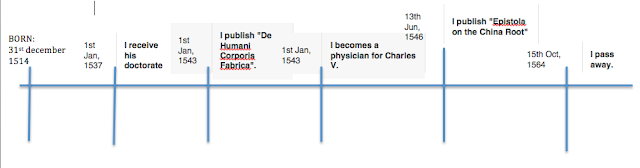
SOME WONDERFUL STUDENTS HAVE EVEN TAKEN THE CARE TO MAKE TIMELINE OF MY AMAZING LIFE:
ANOTHER TIMELINE:
http://www.timetoast.com/timelines/the-life-of-andreas-vesalius
CITATIONS:
http://dodd.cmcvellore.ac.in/hom/12%20-%20Vaselins.jpg
http://www.comptonhistory.com/images/vesalius04.jpg
http://special.lib.gla.ac.uk/images/exhibitions/Bodyimages/Vesalius9.jpg
http://en.wikipedia.org/wiki/Andreas_Vesalius